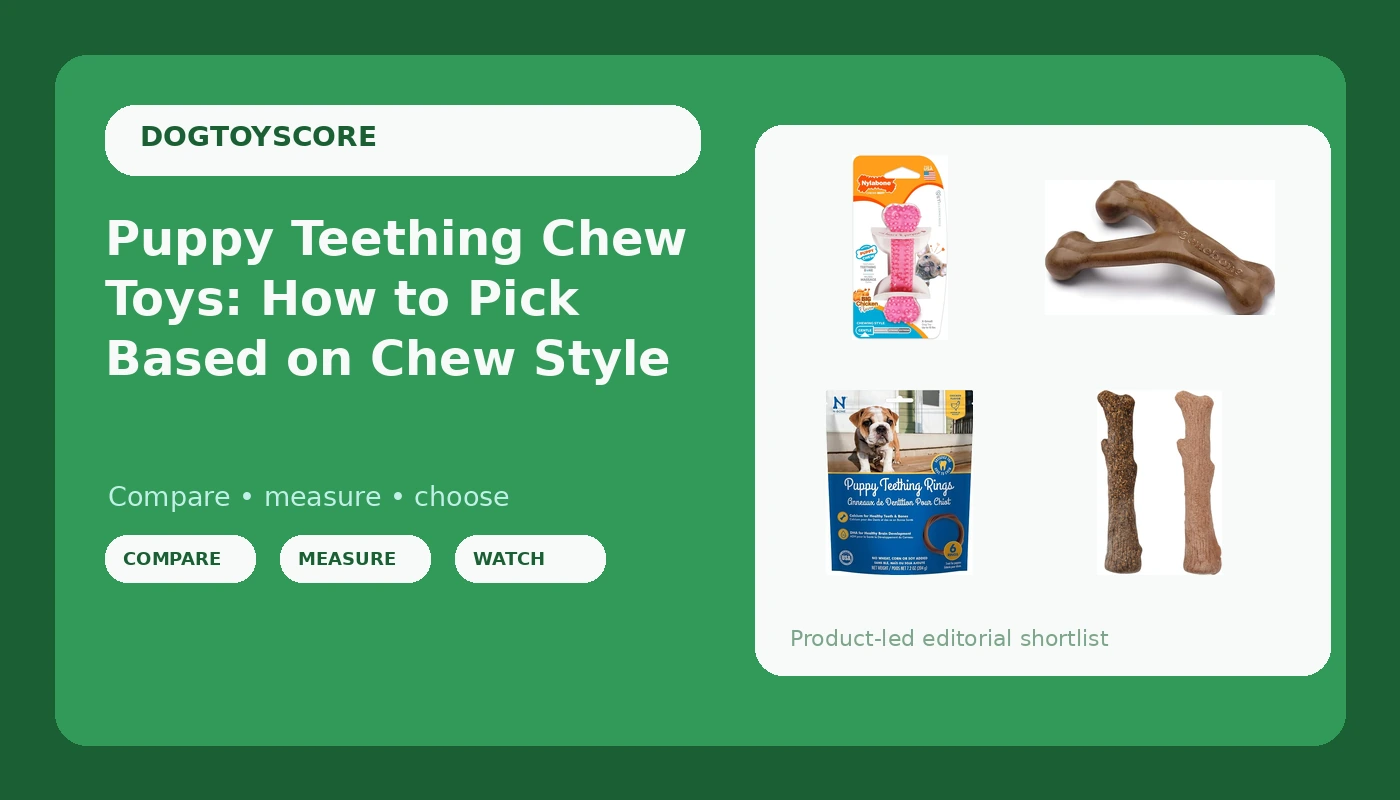
A teething puppy does not read labels. It chews what fits in its mouth, and it stops only when the mouth stops hurting or the chew stops being interesting. That is the whole problem with shopping for puppy teething chew toys: the phrase covers everything from a soft ring that vanishes in minutes to a hard bone that should never go near a nine week old jaw. Buy the wrong one and you either waste money on something your puppy ignores after one sniff, or you hand a small dog something sized for a Lab.
This is not a ranking of which chew is "best." It is a walk through four commonly sold options, what each one is actually built for, and the questions that decide which one belongs in your house this month. Size and chew style come first. Flavor and price come last.
Related: How to Match a Chew Toy to Your Dog's Jaw Size →
Quick answer
Match the chew to jaw size and chew intensity before you look at flavor. For a young puppy in the early teething window, a soft, small, puppy specific chew is the sensible starting point, because small jaws need small surfaces and short chewing sessions. For a dog that has already traded baby teeth for adult teeth and chews with real force, a durable bone or wishbone style chew is the more realistic purchase. Consumable chews and long lasting chews solve different problems: one gives a few supervised minutes of relief, the other survives weeks in a toy basket. Do not label a product the quietest, fastest, safest, or best unless the available evidence supports that distinction.
Four useful options
| Model | Best fit | What stands out |
|---|---|---|
| Nylabone Puppy Chew Pink Textured Teething Dog Bone, X-Small | Young puppies in the early teething window | Small, textured puppy chew bone sized X-Small |
| N-Bone Puppy Teething Rings, Chicken Flavor, 6 Rings | Short, supervised chew sessions for puppies | Consumable chicken flavored rings, calcium enriched |
| Benebone Wishbone Dog Chew Toy for Aggressive Chewers, Real Bacon, Small | Strong chewers with adult teeth | Wishbone shape marketed for aggressive chewers, bacon flavor |
| Dogwood Calming Stick Dog Chew Toy, Medium, 7.5", 2-Pack | Moderate chewers that need variety | Two medium 7.5 inch stick shaped chews |
The starter chew: Nylabone Puppy Chew Pink Textured Teething Dog Bone, X-Small
The case for a small puppy chew is simple: puppy jaws are short, and a chew that is too big is not a challenge, it is a thing the puppy cannot grip. Texture matters too. A textured surface gives a teething puppy something to work at without asking a baby mouth to bite down on a thick, hard edge.
The trade off is lifespan. A puppy chew is designed for a stage, not for a lifetime, and once those adult teeth arrive the same dog may need something sturdier. That does not make the puppy chew a waste. It makes it a stage appropriate purchase, which is a different thing. If you have a dog that already destroys standard toys in an afternoon, this is not the category to shop in.
The consumable option: N-Bone Puppy Teething Rings, Chicken Flavor, 6 Rings
Consumable chews work on a completely different logic than a reusable bone. They are gone when they are gone, which means the puppy gets a defined session, and you get to know exactly how much was eaten. For a puppy that is still learning what chewing is for, that short session is often enough. Puppies have short attention spans and short jaws, and a two minute chew that ends on its own can be more useful than a toy that gets abandoned in the corner.
The trade off is supervision and cost over time. Because they are consumed, they are a recurring purchase, and because they are consumed, you want to be in the room while your puppy works through one. They are also not a durability test. A ring is not supposed to survive a power chewer, so do not judge it by that standard.
The durability pick: Benebone Wishbone Dog Chew Toy for Aggressive Chewers, Real Bacon, Small
This is the category where the label has to be read carefully. A chew marketed for aggressive chewers is built for dogs that have finished teething, and it is the wrong starting point for a young puppy whose teeth are still moving. Small size does not mean puppy toy. Small means small jaw, and a strong small dog with adult teeth is exactly who this shape is for.
The trade off is hardness. Harder chews ask more of teeth, which is why senior dogs and dogs with a history of dental work are not the right audience for the densest options in a toy catalog. If your dog is a heavy chewer, this style is worth having in the rotation for supervised sessions, but it is not the only thing that should ever be in the basket. Rotation is what keeps a chew interesting and keeps any single toy from taking all the wear.
The rotation pick: Dogwood Calming Stick Dog Chew Toy, Medium, 7.5", 2-Pack
Two packs are underrated for one reason: rotation. A chew that has been sitting in a basket for a week is boring. A chew that comes back after four days away is new again. Owning two of the same stick gives you a clean rotation without buying four different products your dog may or may not accept.
The trade off is sizing and chew intensity. Medium is not a universal label. A medium chew suited to a moderate chewer is still the wrong object for a determined power chewer who can compromise a standard toy quickly, and it is oversized for a very small puppy. Check the length against your dog's muzzle and jaw rather than against its breed name.
Prices and availability may change. Product images, names, and retailer links must be matched by verified ASIN. Do not state a current price, rating, stock status, or measured result without current evidence.
Why puppy chews are not just smaller adult chews
Teething is a temporary stage with a clear arc. Puppies work through baby teeth, then lose them, then push adult teeth into place, generally somewhere in the first six to seven months of life. During that window the mouth is uncomfortable in a way that adult dogs simply are not. Chewing applies pressure to gums that feel better under pressure, which is why a puppy will go after a table leg with more commitment than a dog that has never had a dental problem.
That physiology is why puppy products exist as their own category. A chew built for the teething stage tends to be smaller, softer, or consumable, because the goal is short, satisfying sessions rather than long, structural durability. An adult chew built for a strong jaw tends to be denser and longer lasting, because the goal is surviving repeated pressure over months.
Mixing those two categories up is the most common mistake in a pet store aisle. A hard, dense chew handed to a young puppy can be frustrating rather than soothing. A soft, consumable chew handed to a heavy adult chewer is gone before you sit down. Neither product is bad. They are answering different questions.
Size, material, and chew style: the three part test
Before you buy anything, run the same three checks a trainer runs. None of them require a measuring tape, and all of them beat reading the marketing copy.
- Measure the jaw, not the breed. Hold the chew next to your dog's muzzle. If the chew is wider than the muzzle, the dog cannot comfortably work the ends, and if it is small enough to disappear past the back teeth in one motion, it is a choking risk.
- Identify the chew style. Some dogs nibble the edges of a chew for twenty minutes. Others crush and swallow. Consumption style, not size or breed, determines how quickly a chew gets compromised.
- Match material to stage. Puppies in the teething window do well with small, textured, or consumable chews. Dogs with adult teeth and real jaw strength belong in the durable category.
- Check the failure mode. Ask what happens when the chew finally gives out. A crumbled consumable and a splintered hard chew are not the same risk, and neither is a swallowed fragment.
- Rotate instead of upgrading. Three chews on a rotation last longer and stay more interesting than one expensive chew your dog gets bored of on day four.
Keeping any chew in safe rotation
- Supervise new chews, and especially supervise consumable chews until you know how your dog handles them.
- Retire a chew when it is small enough to swallow whole, when it has sharp edges, or when pieces come off under light pressure.
- Keep hard chews away from senior dogs and dogs with known dental issues, and ask your vet if you are unsure about your dog's teeth.
- Wash reusable chews periodically, and let consumable chews be consumable rather than trying to stretch them.
- Give chews on a surface you can inspect afterward, so you notice what came off the chew and what did not.
Which option should you choose?
Choose the Nylabone Puppy Chew Pink Textured Teething Dog Bone, X-Small when you have a young puppy in the early teething stage that needs a small, textured, reusable chew it can actually grip. Choose the N-Bone Puppy Teething Rings, Chicken Flavor, 6 Rings when you want a consumable, chicken flavored chew for short supervised sessions with a puppy that is still learning what chewing is for. Choose the Benebone Wishbone Dog Chew Toy for Aggressive Chewers, Real Bacon, Small when your dog has adult teeth, chews with real force, and needs a durable wishbone to work on. Choose the Dogwood Calming Stick Dog Chew Toy, Medium, 7.5", 2-Pack when you have a moderate chewer and want a two pack that makes rotation easy.
One caveat that applies to all four: there is no universal chew. Size, material, and your dog's individual chew style always matter, and a toy that suits one dog can be wrong for another dog of the same weight. Supervision is not optional during the teething months, and any chew that breaks apart unexpectedly should be removed from the basket immediately.
The bottom line
The teething stage rewards matching over shopping. A young puppy does best with something small, soft, or consumable that fits its jaw today, while a strong adult chewer needs something dense enough to survive repeated sessions. That is why a rotating collection of two or three chews, one starter chew, one consumable option, and one durable piece, tends to work better than a single purchase meant to cover every stage. Buy for the mouth your dog has right now, watch how it chews, and replace anything that starts to fail.